



All eyes will be on Germany’s industrial heartland next month as Euro 2024 kicks off. We explore the region’s heritage, renewal and sporting history
In 1961, future West German chancellor Willy Brandt declared: “The sky above the Ruhr must be blue once more.” His words were greeted with what sounded like applause but was actually his audience falling off their chairs. Because the Ruhrpott, or Ruhrgebiet, an agglomeration of industrial cities that includes Gelsenkirchen (where England will play their opening match of the European Championship this summer), Dortmund (which hosts group matches as well as a semi-final), Essen and Duisburg was a place where the chimneys of the coal, iron and steel industries poked up above the smog like candles on a giant grey birthday cake. You were more likely to slip in unicorn droppings than breathe clean air in the Ruhrpott.
Today the notion of the Ruhr as a tourist destination may provoke as many German sniggers as Brandt’s prophecy back in 1961. But while this region of more than 5 million people may lack the fairytale castles of Bavaria or the coolness of Berlin, there’s plenty to divert the thousands of fans who will pour into the region in June and July. And that’s even if you leave aside the rich football heritage of the mighty Borussia Dortmund and Schalke 04, and perennial battlers such as Rot-Weiss Essen, Bochum and Duisburg.
The deeds and personalities of the region’s great players are commemorated everywhere with wall plaques and massive murals. One is devoted to Dortmund’s 1950s hero Max Michallek, a title-winning veteran defender whose curt reply to Hamburg star Uwe Seeler’s crack about his age, “Even when I’m 70 I’ll stop you!” is the stuff of local legend.
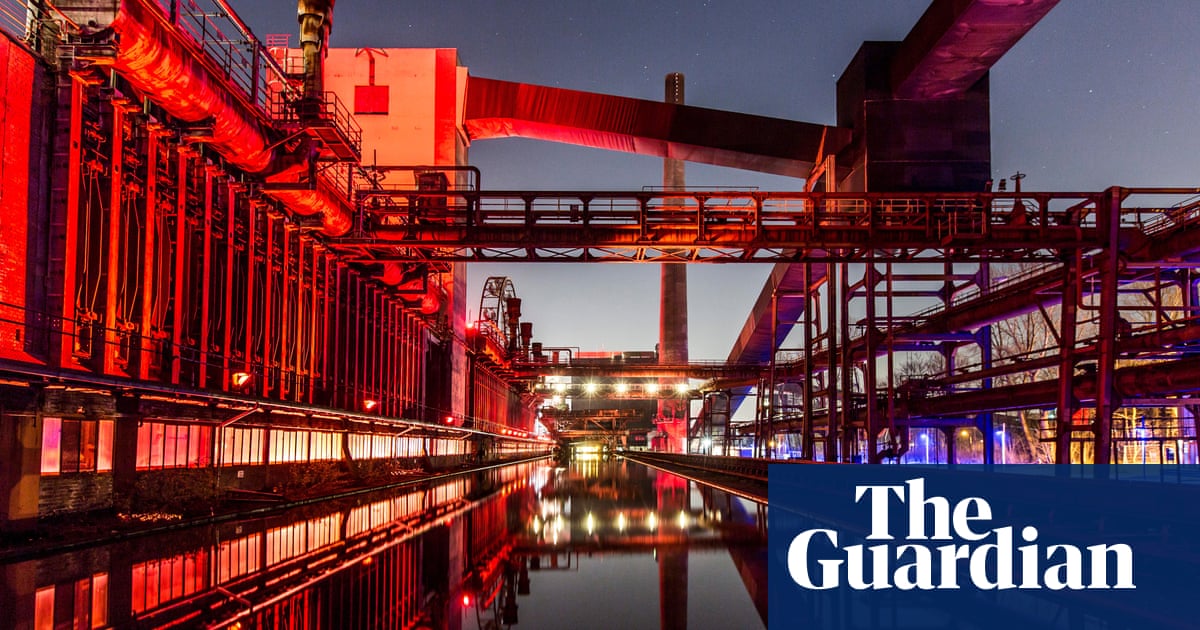
The Ruhrgebiet is accurately described as the industrial valley of the kings. Everything here was built on an epic scale, whether it’s the steel and brick edifice of Zeche Zollverein, once the biggest coalmine in Europe and now a Unesco world heritage site; or Villa Hügel, 19th-century industrialist Alfred Krupp’s 399-room mansion; or the glowing “U” that tops the 75-metre high tower that housed the Dortmunder Union brewery.
Even the Lichtburg, Essen’s classic 1920s cinema (such a model of pre-war German movie-star elegance it’s a surprise not to find Marlene Dietrich propping up the bar) is the largest in Germany.
Much of the heavy industry has gone (the last coalmine closed in 2018), but there’s still an impressive amount left. From the Alsumer Berg (like most of the mound-like hills that dot the Ruhr, it’s a former waste dump), where on a fresh spring morning snowy blossom drips from blackthorn trees and thrushes trill beneath a sky which – fulfilling Brandt’s prediction – is as clear and blue as a baby’s eyes, you can look down on the ThyssenKrupp iron and steel plant. It’s a metal metropolis of rolling mills, cooling towers, conveyors and serpentine lengths of pipework wide enough to drive a car through.
On the swirling Rhine, huge barges push up towards the works from Rotterdam, humping coal and iron ore. Railway trucks laden with limestone rattle over bridges and viaducts. Periodically the coking plant is fired, then doused. Clouds of steam spew and excess gas combusts in flare stacks. The sulphurous dragon-breath whiff tickles your nostrils. All this effort is to feed the monstrous appetites of a pair of blackened blast furnaces known locally as “the two dark giants”. To those for whom heavy industry is wreathed in romance and mythology, ThyssenKrupp is a hard hat Middle-earth.
An hour after descending the Alsumer Berg, I’m standing on top of another massive blast furnace, the decommissioned behemoth at the centre of the Duisburg-Nord landscape park. Below, families sit beneath the cherry trees eating currywurst with chips and dollops of mayonnaise. This spicy, sticky mix is one of the Ruhr’s great culinary delicacies. The Dönninghaus in Bochum claims to make the best bratwurst in the world.
Duisburg-Nord is a masterpiece of imaginative repurposing. The gasometer is now a scuba diving pool and the great concrete storage bins have become climbing walls. More surprisingly, it has become a popular photographic backdrop for those with more niche interests. During my visit I saw a man dressed as an intergalactic warlord brandishing a ray gun, a couple decked in full rubber fetish gear and a manga-style schoolgirl being menaced by a mutant creature with chainsaws for arms. It’s not the sort of thing you’d come across at, say, Beamish Open Air Museum on a Saturday morning, but it suggests that the public have embraced the place.
The same holds true – albeit without the cosplay – of the Oberhausen Gasometer. Standing close to 120 metres in height, the 24-sided steel tower once stored coal and blast furnace gases. Today it’s an exhibition centre that attracts up to 100,000 visitors a day. For all of 2024 the halls are given over to a show about the oceans. On the 40-metre-high projection screen that lines one wall, giant luminous jellyfish float upwards into the darkness.
Further east is Duisburg’s inner harbour, where rows of towering Victorian grain stores and flour mills once supplied workers’ daily bread. Now they are art galleries and restaurants. I survey canvases by Anselm Kiefer and Gerhard Richter before demolishing a big slab of sour-sweet plum streusel cake on a terrace overlooking the water.
West along the canal and outlined against the grassy mounds of spoil heaps (all topped by works of art, including Genth and Mutter’s vertigo-inducing rollercoaster staircase the Tiger and Turtle – Magic Mountain) is the pale, rounded outline of the Veltins-Arena in Gelsenkirchen, home of Schalke. The stadium is named after the sponsor, a brewery whose beer is pumped directly into the stadium via a three-mile pipeline.
Sign up to The Traveller
Get travel inspiration, featured trips and local tips for your next break, as well as the latest deals from Guardian Holidays
after newsletter promotion
Schalke left its original ground, the Glückauf-Kampfbahn (Glück auf was the traditional miners’ greeting) in 1973. It’s still standing, preserved for its elegant 1920s entrance and main stand, and is a pre-match meeting place for fans. At one time many of the players were pitmen at the city’s Consol mine, whose winding tower is a monument. The teams used to go for post-training beers to Bosch, the atmospheric bar next to the Glückauf: its walls are decorated with photos of greats of the past, including scoring phenomenon Ernst Kuzorra.
A greater measure of the place Schalke holds in the local imagination can be found in St Joseph’s church. No longer used for services, its altar is decorated in the royal blue and white Schalke colours, and scarves are plastered across its walls. A stained-glass window features Saint Aloysius dressed as a renaissance prince, except for his sturdy football boots. His cloak is blue and white; a ball rests at his feet. He appears ready to run on to the field, though even in the rumbustious 1950s it’s hard to imagine the referee would have allowed him to play while carrying such a big dagger.
Franz Beckenbauer called the Ruhr “the beating heart of German football”. (It’s a measure of regional influence that Toni Turek from Duisburg was the goalkeeper when West Germany won their first World Cup in 1954, Manuel Neuer from Gelsenkirchen when they won their fourth.) So it’s fitting that the national football museum is up the road in the home of Schalke’s rivals, Borussia Dortmund. Here fans of a certain age can get a sweet, misty-eyed hit from vintage Adidas shirts, pose beside the giant photo of Helmut Rahn from Essen (goal-scoring hero of West Germany’s surprise World Cup final victory in 1954) and vote on whether Geoff Hurst’s infamous goal in 1966 (the keeper, Hans Tilkowski, came from Dortmund) actually crossed the line.
On Bochumer Straße in Gelsenkirchen, a revitalised quarter is clustered around the imposing 1920s Heilig-Kreuz church. Now a performance space, it’s entered through doors designed to resemble the entrances of pit shafts. The massive, pillar-less interior feels like the belly of a whale. In the streets around it are artists’ studios, cafes, vintage stores, restaurants and bars including the excellent Trinkhalle Am Flöz.
Like football, beer is integral to life in the Ruhrpott. In Frohnhauser Sudwerkstatt, a microbrewery and one-room bar in Essen, owner-brewer Peter is an evangelist for British ale. He opened his doors in February uncertain of what to expect. “I didn’t know if people here would like my beer, but you see …” he gestures to a bar whose every square foot is occupied by a German glorying in their first experience of chocolate porter or dark mild.
Later, in Essen’s Holy Craft Süd, drinking unfiltered export pilsner made by brewery Mücke (named after a heroic pit pony from the Zollverein mine), a local bemoans the changes he has seen over his lifetime. “Young people now, they don’t know how it was. When the blast furnaces were working here in the city, at night they turned the whole sky orange.”
Where heavy industry is gone, nostalgia is sure to move in. But it doesn’t have to be all that is left. Rebuilding is tough, but in the Ruhr, a land filled with the skeletons of industrial giants, maybe there are growing signs that a compromise can be reached, that you can merge tradition with modernity, pairing currywurst with a hazy IPA beneath a smokeless sky.

Chief Editor
As the Editor-In-Chief at Fridayposts, my commitment is to make valuable, insightful and useful articles and latest news contents available to our highly esteemed readers and subscribers.
Add A Comment