



Eze Onyekpere
The idea of exploring and exploiting the full value chain of agricultural products sounds very appealing. It is most appealing considering that these are what we produce in large quantities and most times, allow the produce to rot in post-harvest losses. This impoverishes the farmer and rural dwellers, who spend most of their time producing crops and animals that do not realise their market potential, due to no fault of theirs. It is further appealing because we are not discussing a concept that will make a few very well-positioned Nigerians rich, but a bottom-up approach which will improve the lives and livelihoods of millions of people at the grassroots.
The value chain approach to agriculture is a wonderful one and deserves the support of all well-meaning Nigerians who desire the country’s development and economic growth. I may be wrong, but it appears the profound noise about value chains started with the former agriculture minister, Adesina Akinwumi, who is now the President of the African Development Bank. It continued with his successor, Audu Ogbeh, under President Muhammadu Buhari’s first tenure. We do not yet know who will be the new Minister of Agriculture or whether there will be continuity. But what has actually happened or been achieved under these regimes in terms of activating value chains for the take-off of the Nigerian economy?
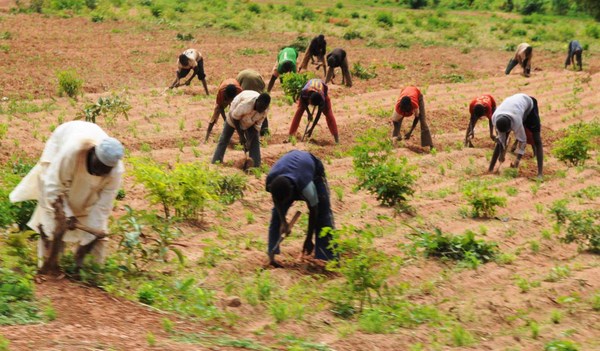
Before we resolve this question, we must appreciate what a value chain proposes for a crop. It starts from getting the best seeds or stem cuts for planting and these will be inputs that increase the yield per hectare, are disease resistant, and adaptable to changing climatic conditions. They may mature early and not be disproportionately sized to create harvesting encumbrances. The value chain will also import a clearer understanding of the natural and artificial fertilizers that will deliver the best results, not in the short run but in the medium and long terms. It will proceed to proper planting techniques, weeding, harvesting. This may involve the use of appropriate technology beyond the manual and drudgery approach to farming, which scares away to the youth and puts unnecessary pressure on female farmers. Storage comes next to minimise post-harvest losses and extending the shelf life of these crop products in their original forms.
Beyond the general supposedly gender-neutral ideas on agricultural productivity, the value chain concept must respond to the role of women in agricultural production by providing labour reducing and cheap implements for improved productivity. The equipment may not be big tractors, requiring so much management and repair costs, but the equivalent of hand-pushed mechanised equipment that will render the same service as big tractors. And the beauty of this is that they can be locally produced, fabricated and maintained.
Value chain thereafter enters the full gamut of processing into various finished and semi-finished products for industry and services. A particular crop, for instance, cassava, yam or the palm fruit can be processed as an input/raw material for products in the food, pharmaceutical, garment, cosmetics, etc. industries. At this stage, preservation, phytosanitary processes and stipulations, international and regional standards and specifications come to play. Of course, trade policy, branding, industrial and labour policy, tariff and non-tariff measures come to play in proper packaging and penetration of the regional and international markets while proper economic policies support the use of the products at the domestic level from an import substitution perspective.
A proper value chain approach identifies local research and educational institutes like universities of agriculture, colleges of agriculture, polytechnics and faculties of agriculture in tertiary institutions. They form the engine room of research for improved crop yield, disease resistance and extension of shelf life. Their research is tied to their location, community and environment, who are the necessary off-takers, waiting for their research output to produce improvements in value chain outcomes. This also creates room for enhanced extension services as these institutes, tertiary institutions and research centres will be bound to go into the nook and cranny of their catchment areas to improve productivity with their research outputs. Thus, the town and gown will meet and tertiary institutions’ knowledge will no longer be about science that has no links with technology and or technology that stays put in the lab without commercialisation. Essentially, tertiary agriculture institution research will no longer be for the shelves and libraries. It will be evidence-led and respond to the real-life challenges of the surrounding communities.
Again, the value chain approach identifies the research and production institutes that have produced machinery and facilities for the processing of local crops in the full value chain approach, empowers them so that they can move from research to production. This is even more so demanded as most of the research institutes in Nigeria are publicly funded and the Ministry of Agriculture is spending public funds. So, some level of public-public collaboration and partnership is required in an innovative approach beyond what is listed in economic orthodoxy of public-private partnership. The second leg of this is to collaborate in a public-private partnership approach with local fabricators and producers of agriculture processing machinery and equipment. Thus, they will move the research to a composite level of production that will generate profits, create jobs and increase taxable income at the individual and firm levels.
So, what exactly happened to our value chains in agriculture? The first thing that happened is that the Ministry of Agriculture misunderstood the value chain concept and this led to very few results far in between. There was also a mistaking of sloganeering for the real deal. The slogan was elevated beyond the action and the changes that needed to be made; this led to stagnation; motion without movement translating into a motion in barbers’ chair. The second and most unfortunate development was that with the exception of a few instances, the federal government was leading an idea which should have been led by state and local governments. Thus, states and local governments literally stood aloof and allowed the federal government to play the music as well as being the key dancer. The federal government owns no land in states and does not understand the local issues in agricultural production beyond the big policy picture. It is states with their local governments who should have taken the lead in the agriculture value chains with micro, small and medium industries which aggregately will produce enough to fill the gaps and have enough for export.
With local fabrication, many of the processing plants may cost in tens of millions which can be sourced at the local level with federal government supplementation where necessary. In essence, a paradigm shift is needed which involves a federal, state and local government collaboration under a memorandum of understanding with clear milestones, targets and deliverables and with supervision and oversight by civil society to improve the value chain production and deliverables.
Understanding what works and a clear governance mechanism is imperative for the promises of agricultural value chains to materialise. It is doable and can be done.
[Punch]
