



Charles Onunaiju
At the launch of the operational phase of the 54-member nation, the African Continental Free Trade Area agreement in the Nigerien capital, Niamey, early this month, the chairperson of the African Union Commission, Mousa Faki Mahamat, described it as a “historic moment” and added that “the speedy entry into force of AfCFTA has been a major pride to all of us”.
Underscoring the expansive trajectory of the trade agreement, Mr. Faki Mahamat said that it is “more than just free trade area but by excellence, the instrument of industrialisation and integration with an objective of the aspiration of the agenda 2063.”
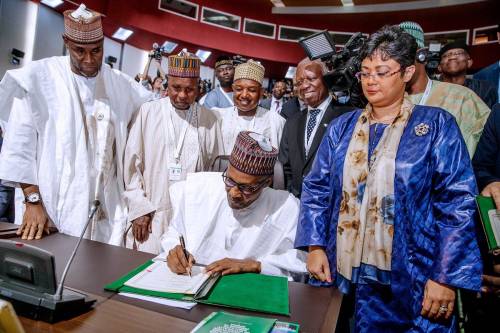
Earlier at the event, Presidents Muhammadu Buhari (Nigeria) and Tallon (Benin Republic) signed the document to accede to the free trade agreement, bringing to 54, the number of African countries that have signed up, leaving out only Eritrea. However, the 12th Extraordinary summit of the African Union Heads of State and government in Niamey, the capital of Niger, is not the only “historic moment” in Africa’s search for integration, common market and free trade area.
The most historically momentous was actually the ambitious Lagos Plan of Action and the final Act of Lagos of April 1980, a significant and audacious continental effort to chart a formidable road map for building huge regional economies of scale with full complements of strategic and key economic convergences to drive functional integration and regional market through massive outlays of infrastructural and industrial networks. Shortly after the historic Lagos Plan of Action and its counterpart, final Act of Lagos, the Bretton Wood Institutions along with the US Treasury Department issued a rival document of stabilisation and structural adjustment programme which eventually had its way, while the African regional initiative struggled for a space in the shelves.
Again on June 3, 1991, 51 African states acceded to the African Economic Community, another watershed in Africa’s regional effort to articulate a road map to economic recovery and sustainable development after the failure of the neo-liberal Washington Consensus that drove the structural Adjustment program of the 1980s. The African Economic Community did not, however, seek to overthrow liberalism or market reforms, but sought to harness its advantages through the benefits of economies of scale. Building from the formidable insight of the April, 1980 Lagos Plan of Action and the Final Act of Lagos, the African Economic Treaty sought among other objectives “the promotion and strengthening of joint investment in production and trade of major products and input within the framework of collective self-reliance.
“The liberalisation of trade through abolition, among member states of custom duties levied on imports and exports and the abolition, among member states of non-tariff barriers in order to establish a free trade area at the level of each regional economic community.
The harmonisation of national policies in order to promote community activities, particularly in the field of agriculture, industry, transport and communication, energy, natural resources, education, culture, science and technology.
The adoption of a common trade policy vis-à-vis that states.
The establishment of and maintenance of a common external tariff.
The establishment of a common market”
The above objectives among others were elaborately stated in the treaty of the African Economic Community and were not different from the objectives of the Continental Free Area that has just been launched, even as the historic Lagos Plan of Action was more comprehensive and far more compellingly strategic to the vision of regional integration with the full complements of common market and free trade area. More curiously, the Peoples Republic of China, whose GDP then, in the late 1970s and early 1980s, was lower than some African countries, launched her key economic modernisation programme of reform and opening-up around the same time of the Lagos Plan Action. While Beijing stayed the course of her homegrown reform effort, with less economic endowment but a strong political will and discipline to persevere, Africa’s continental initiative as homegrown reform suffered a deadly ambush by extra-regional powers. Forty years down the line, China’s GDP has multiplied over 84 times more than any African country’s economy, pulled 840 million Chinese out of poverty and became the second largest economy in the world.
From almost zero trade profile in the 1970s, China is the world’s most vigorous trader now and has been Africa’s largest trading partner for the past 10 years in a straight row.
The AfCFTA whose journey in the public domain, began in the Rwandan capital, Kigali, last year with high profile accession of its instrument by several states on the continent, received its “historic moments”, with the launch of its operational phase in Niamey recently must critically examine itself in the mirror and find out, why its many illustrious predecessors buckled. There are certainly new conditions both in the world and Africa that could help the resurrected efforts at regional integration, common market and free trade area to reach a modest success. Regional or continental facility connectivity through infrastructure renewal, currently at the heart of China-Africa Cooperation and embedded in Beijing-initiated framework of the Belt and Road International Cooperation can contribute meaningfully to necessary indices conducive for a functional and successful free trade area.
But the momentum that would make AfCFTA succeed must be generated from within and the top most among them is policy alignment or coordination of participating countries to enhance institutional connectivity. This means significant trade-off of institutional and policy sovereignty. Africa has done these generously with prodding of enticements and blackmail for many years by extra-continental Western powers and institutions and should therefore, not shy away from contributing some bits of their sovereign prerogatives to the internal initiatives and momentum to build a free trade area, common market and drive the integration of the region.
The Africa’s newest kid on the block, AfCFTA, can walk and even run, but strategic fundamentals must be put in place for operational market and economic indices to function optimally on their own accord. Africa has a unique international advantage of a growing and expansive multi-lateralism with an international system less beholden to a dominant “hyper-power” or any rampaging ideological pole, leaving her open to seek broad partnership across the world than the previous Cold War narrow manoeuvre of finding allies to fend off prospective foes.
More importantly, let there be no illusion that the AfCFTA, even as it enters the operational phase, would bring quick results and relieve Africa immediately of the immense burden of poverty of the majority of her population.
The immediate need or imperative of the current continental initiative is to stay the course with uncommon focus and consistency, wading through the river by feeling stones, as Chinese great reformer, Deng Xiaoping, called out his people at their Long March to economic stardom, 40 years ago.
- Onunaiju is director, Centre for China Studies, Utako, Abuja
[Punch]
