



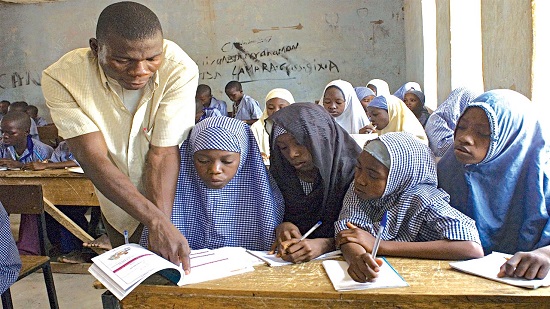
For Usana Bashir, 11-year-old girl, life starts very early in the morning. Her life was all about selling “sachets of water”. Clad in a faded, torn shirt with a bowl of water sachets loosely placed on her head, Usana has to eke out a livelihood for the family.
Daily, she would walk a long distance in the Ungogo Local Government Area of Kano State, as she struggles to keep pace with moving vehicles on the busy roads to sell her “sachets of water” – a strenuous life that has made her look sick and stunted.
Usana’s day starts about 10a.m. and she returns to her home when she exhausts the load handed to her by her parents.
The little money from Usana’s sales ensured that her family had a source of livelihood. She did that as her contribution to the economic survival of a family of eight for many years until a day her parents decided to tap into an opportunity a friend discussed with them. They decided to enrol Usana in one of the Integrated Qur’an Schools (IQS) in the local council.
Gradually, Usana swapped her bowl of “sachets of water” for western education. She is now a female pupil, who dropped hawking and has been benefitting from the new system.
The girl is enjoying the new challenge thrown up by the new system of IQS education. She hopes to be a police officer.
Like Usana, 18-year-old Dausiyya Yushau of Government Girls Junior Arabic Secondary School, Tarda, Ungogo Local Government Area of Kano State, also decided to embrace western education because of the intervention of mothers’association.
Dausiyya, in an interview, said the house-to-house campaign by mothers’ association – an group of women pushing for girls’ education in northern Nigeria – on the benefit of sending the girl-child to school, was yielding the desired results.
She said: “I am a product of the campaign by the mothers’ association that came to meet my parents on the need for me to be in school and also complete my education.
“After the campaign, my parents pleaded with me to return to school and that education is the only key to my success in life. I obeyed and told myself that I must finish schooling before getting married.
“I am 18 years and will sit for my junior WASCE in less than two months, and afterward pursue my senior secondary school certificate.
“I would love to be a doctor and to achieve this means I must pursue my education to the tertiary level. I give this credit to the intervention of the mothers’ association.”
A cheering news on girls’ enrolment
Like Usana and Dausiyya, hordes of kids in northern states are beginning to embrace modern education like their counterparts in other parts of the country. For years, the region had frowned at western education, which many saw as evil. The persistent resistance of western education, especially by the Almajirai, had increased the number of out-of-school children.
According to the 2018 National Personnel Audit conducted by the Universal Basic Education Commission for Primary Schools, Nigeria has about 10,193,918 out-of-school kids, with many concentrated in the North and who are mostly Almajirai.
Going by the figures obtained from the Universal Basic Education Commission (UBEC), enrolment rates of girls in primary schools in the Northwest, particularly in Kano, Katsina and Jigawa states is on the increase.
The figures showed that more girls aged between six and 11 have been enrolled in schools in three northern states.
A breakdown of the figures showed that Kano State had 1,883,105 girls enrolled in school. Katsina had 966,859 girls in school and Jigawa recorded 503,968.
In total, about 1.3 million girls have been enrolled in the Northwest through the Girls Education Project (GEP3), supported by the Foreign, Commonwealth and Development Office (FCDO) of the United Kingdom.
However, Kano still has 240,766 girls that are out of school. Katsina has 267,132 girls that are not in school and Jigawa has 113,310 girls.
In a recent presentation, Education Specialist for the United Nations Children Fund, Field Office Kano, Muntaka Mukhtar, noted that many girls were dropping out of school because of cultural norms.
Mukhtar, who stated these during a media dialogue in Kano, said this had affected their transition to secondary school.
The dialogue, which was focused on girls’ education under GEP3, is being implemented in Sokoto, Kano, Katsina, Zamfara, Bauchi and Niger by UNICEF. The £79, 029, 241.85 project funded by FCDO started in 2012 and will end in September.
Mukhtar said: “In the North, we have more girls within this population (six to 11 years). The implication is that most girls either start school too early or are enrolled too late. If they enrol too late, in the northern tradition, it is going to have repercussions in their transition to JSS and to Senior Secondary school.”
How mothers’ association is driving education surge
One of the incentives to drive and return kids to school in the North was the introduction of the conditional cash transfers by UNICEF.
It is one of the many incentives of UNICEF to help boost the livelihoods of families in the north and ensure that mothers receive support that will reduce the burden of paying school fees on the family.
As part of the incentive, mothers in Ungogo Local Government Council Area, received an unconditional cash transfer of N45,000, paid twice directly into their bank accounts.
According to the women, they channelled the money paid by UNICEF and FCDO into their businesses, thereby helping to improve the well-being of their households.
A member of the association in Ungogo, Hajia Asmau Mustapha, explained the role played by the association in the drastic reduction of out-of-school girls in the locality.
Hajia Mustapha said the funds given to parents had solved the problems of parents not sending their children, especially the girl-child to school.
According to her, we want the sustainability of the programme because we learnt the initiative will come to an end in September, but we want the government to take it up.
She said: “Before this programme, only two towns around here sent their children to school located here, but surprisingly, other towns around now send their children to school. This is a milestone achievement as it has improved enrolment in the school and so we want it sustained beyond September.
“The School Based Management Committee (SBMC) constituted female committees that moved from house-to-house to enlighten parents on the need to send their children to school.This committee has done a lot in positively influencing parents and the result is the increase in enrolment of the girl-child we see in many of our schools in Kano State.”
Enrolment project exceeds target
To the Education Manager, Kano State UNICEF Field Office, Michael Banda, the Girl-Child Enrolment Project had exceeded its initial target of one million across the targetted states – Katsina, Kano, Bauchi, Zamfara, Sokoto and Niger.
He noted that the impact of the GEP3 was meant to improve social and economic opportunity for girls in target states, complete basic education and acquire skills for life and livelihoods.
Banda said: “The key interventions include among others community enrolment drives by the School Based Management Committee (SBMCS) and Mothers’ Association with support from state and Local Government Education Authorities (LGEA).”
On the learning outcomes of the girls, Banda said the end line percentage of pupils achieving basic literacy had increased from about 10 per cent at baseline to about 32 and 40 per cent at midline and end line in the GEP3 intervention schools.
He said over 10,000 teachers and facilitators had been trained through GEP3, with teachers’ effectiveness.
Banda also revealed that UNICEF had also supported UBEC in the development and dissemination of Safe Schools Guidelines.
He said the GEP3 project had also led to the enrolment of about 1.3 million girls in primary and Integrated Qur’anic Schools (IQS) in the targetted six northern states.
Why girls’ education is important, by UNICEF’s specialist
For UNICEF’s Education Specialist, Azuka Menkiti, there is the need for Nigeria to prioritise education for the girl-child. She noted that an educated girl-child can lift her family while also contributing to the socio-economic development of the country.
According to Menkiti, when girls are educated, the rate of child mortality will decrease and the number of child malnutrition in Nigeria will reduce.
Menkiti said: “If girls are educated, there is clear evidence that it will decrease the rate of child mortality. There is evidence that girls’ education will reduce the number of child malnutrition in Nigeria.
“Girls’ education is not just about bringing them to come and sit in the classrooms. It is a huge project that by the time she goes through it, the girl will be able to stand tall and be able to contribute meaningfully to her community and make a positive impact even within her family.
“While progress has been made globally in bridging the gap in girl education, we are still lagging behind in Nigeria and sub-Saharan countries. The girl still faces a lot of issues. She is living with common gender norms, which put girls at a disadvantage that leads them to drop out of school at a very high rate; pushing parents to prioritise education for boys.
“Every day, girls face barriers to education caused by poverty, cultural norms and practices, poor infrastructure in schools and different violence and fragility.”
The UNICEF education specialist, therefore, urged leaders to invest in secondary education for girls.
“Education is an important building block and most impactful way to empower girls,” she said.
More needs to be done
On his part, Chief of Field Office, UNICEF Field Office, Kano, Rahama Farah, noted that a lot still needed to be done to ensure that every girl in Nigeria is enrolled, attended school and completed her education.
Farah stated: “To achieve this objective, we need the support of every ally and stakeholder, especially the media. I urge the media to advocate for increased funding and allocation of adequate public resources to the education sector, especially adequate allocation and the release of what have been appropriated.
“There are a number of barriers that affect girls’ education. The media must also be at the forefront of advocating for the action directed at removing these barriers that hinder girls’ education such as child marriage.
“I would like to express UNICEF’s appreciation to the Foreign, Commonwealth and Development Office (FCDO) of the UK for funding the Girls’ Education Project 3, which started in 2012. This project has expanded access to education for girls, resulting in no fewer than 1.3 million girls having access to education in northern Nigeria.
“With more of similar support, and working together with government and development partners, parents, communities, traditional and religious leaders, we can achieve more by enrolling more girls in schools, and ensuring they complete their full education.”
