


Nigeria’s next president who is expected to be announced in a matter of hours – or days, if the elections goes into a run-off, will have to embark on a number of critical reforms when he assumes office in May, 2023, in order to reset the struggling economy, writes Obinna Chima
In the next few hours or days, the Independent National Electoral Commission (INEC) would be expected to announce the winner of Nigeria’s 2023 presidential election that began last Saturday. The next president would assume office on May 29th, 2023. Indeed, one issue that he would be confronted with is how to fix the Nigerian economy, which has been underperforming for the past few years.
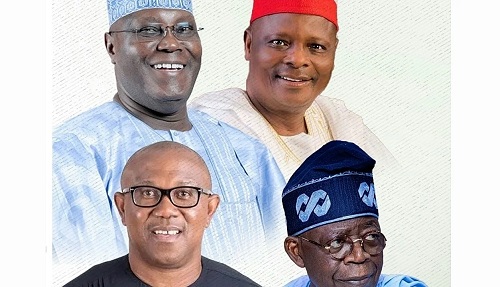
Presently, the top four presidential candidates are Bola Tinubu of the All Progressives Congress (APC), Peter Obi of the Labour Party (LP), Atiku Abubakar of the Peoples Democratic Party (PDP) and Rabiu Kwankwaso of the New Nigeria Peoples Party (NNPP).
Nigeria’s annual Gross Domestic Product (GDP) growth rate slowed to 3.10 per cent in 2022, compared to 3.40 per cent in 2021, latest data released by the National Bureau of Statistics (NBS) last week revealed. However, the economy grew by 3.52 per cent (year-on-year) in real terms in the fourth quarter of 2022 (Q4 2022), compared to 2.25 per cent in the preceding quarter, the NBS stated.
According to the GDP Report for Q4 2022, which was posted on the NBS website, aggregate GDP stood at N56.76 trillion compared to N49.28 trillion in Q4 2021, indicating a year-on-year nominal growth of 15.18 per cent. Real GDP stood at N21.04 trillion in Q4 2022.
The economy was largely driven by the non-oil sector which accounted for 95.66 per cent of growth while the oil sector contributed 4.34 per cent.
The average daily oil production increased to 1.34 million barrels per day (mbpd), in the quarter under review, compared to 1.20 mbpd in the preceding quarter but lower than the 1.50mbpd recorded in the same quarter of 2021. According to the statistical agency, GDP performance in Q4 was driven mainly by the services sector which contributed 56.27 per cent to growth.
Agriculture contributed 24.90 per cent to nominal GDP in Q4, but lower than 27.55 per cent recorded in the preceding quarter. Overall, in real terms, the sector contributed 24.05 per cent in 2022.
The NBS pointed out that agriculture was significantly hampered by severe incidences of flood, experienced across the country, accounting for lesser growth, relative to the fourth quarter of 2021 which was 3.58 per cent.
The sector thus recorded -0.94 per cent growth and contributed less to the aggregate GDP, relative to the third quarter of 2022 and the fourth quarter of 2021. Manufacturing contributed 8.40 per cent to real GDP, lower than 8.59 per cent in Q3 and 8.46 per cent in the corresponding quarter.
Trade’s contribution to nominal GDP stood at 13.20 per cent in Q4, higher than 12.45 per cent in the preceding quarter.
Furthermore, the information and communication sector contributed 16.22 per cent to growth in Q4, higher than 15.35 per cent in the preceding quarter and 15.21 per cent in Q4 2021. The sector contributed 16.51 per cent to GDP in 2022, higher than the 15.51 per cent reported last year.
In addition, the country’s is also faced with other socio-economic problem such as dwindling oil revenue, high number of out-of-school children, energy poverty, exchange rate volatility, inequality and poverty, which inhibit the realisation of basic human rights such as education and health care, which are indispensable for sustainable development.
Regrettable, despite the President Muhammadu Buhari-led administration’s target of lifting 100 million Nigerians out of poverty over the next 10 years, no fewer than 133 million Nigerians, representing 63 per cent of the population are currently living in multi-dimensional poverty. Of the total, 105.98 million poor Nigerians are located in rural areas compared to 16.97 million in urban areas. According to the Nigeria Multidimensional Poverty Index (MPI) 2022 Survey, there are high deprivations in sanitation, time to healthcare, food insecurity, and housing.
Also, poor people were said to experience over one-quarter of all possible deprivations. Moreover, both the incidence and intensity of poverty at 62.9 per cent and 40.9 per cent respectively exceeded the 26 per cent poverty cut-off threshold. The report stated that over half of the 200 million population who are multi-dimensionally poor, cook with dung, wood, or charcoal, rather than clean energy.
To the Minister of Finance, Budget and National Planning, Mrs. Zainab Ahmed, President Muhammadu Buhari’s administration has laid good foundational work for the incoming administration to build on and deliver good governance and prosperity to Nigerian.
Ahmed also disclosed that one major thing that keeps her awake at night was how to source revenue to implement crucial programmes of the government, adding that a lot of Nigerians do not think that there is anything wrong about not paying their taxes.
The minister said: “It is always good to remember that Buhari’s administration has gone through several crises and still managed to keep the economy growing.
“Just on Wednesday, we released our most current GDP report and the economy has grown at 3.52 per cent. So it’s been very difficult. It’s not the best of times. We have had the worst that could have happened thrown at us during this administration.
“Despite that, we’ve seen growth and we’ve also seen an increase in infrastructure and also an expansion of social programmes that impacted the lives of people as well as expansion of investments in education, health, as well as in social investment that is meant to address the most vulnerable segments of our society.”
She added: “On the issue of tax, it is still low compared to our GDP, but the absolute number on the taxes collected is increasing at a rapid rate. For example, in 2021, the total collection of tax was N6 trillion, in 2022, that moved to N10 trillion.
“But again, as has been mentioned on the fiscal side, that there’s a lot that we need to do to reduce the costs of governance because our expenditure is growing faster than the revenues by almost twofold on an annual basis.”
Ahmed also harped on the need to rebuild the social contract between the citizens and the government on a constant basis because the world itself is dynamic, adding that the Buhari administration, “has started what whichever government that comes in will continue with and we hope it is the same ruling party, so it becomes easier.”
She, however, noted that “revenue shortfalls keep me awake because you need finances to fund salaries, pensions, elections and infrastructure. And we have a massive census also coming up in April. So, in 2023, we have huge expenditures spending in one year, and it keeps me awake at night.
“A lot of Nigerians do not think that there is something wrong in not paying their taxes. Before, we had responsible citizens that paid taxes. But since we discovered oil and moved toward a rent state, the culture of tax payment just dissipated into the air. But it doesn’t add up and doesn’t work that way. Every citizen has to be responsible.”
To a former Deputy Governor of the Central Bank of Nigeria (CBN), Prof. Kingsley Moghalu, the rate of diversification of the Nigerian economy has not taken place in a manner necessary for rent-seeking to stop.
He argued: “What Nigeria needs is foreign exchange diversification. We need an export-led economy that is driven by complex value added growth across a number of areas to create an inclusive economy.”
He said the next government must work on the fundamental things holding Nigeria back from achieving prosperity for its 200 million citizens.
Moghalu said Nigeria’s economic crises lies at its constitutional structure that makes the central government extremely attractive.
He said: “There are two things the new government that is coming in must do. First, we must increase the supply of our oxygen. And that implies that we must deal with the fiscal crises. That is basic. We must increase our revenue. The second thing is that the next government must address the waste and corruption in governance by bringing in very competent professionals to manage the economy and stop corruption.
“The challenge of the next government is the ability of its leadership to put the right things in place to stop the vested interests and put the people first. And to be very transparent about policies and ensure that critical institutions like the central bank and the judiciary do not become political balls.”
Analysts also stressed the need for the next president of Nigeria to take direct ownership and leadership of the power sector, adding that, in the area of transmission infrastructure enhancement, the president must mandate the key players and have one responsible individual – be it the Minister of Power, preferably, or if required, consider the option of Presidential Taskforce on Power, as was the case under Prof. Barth Nnaji, some years ago.
According to the Chief Executive Officer of Proton Energy, Mr. Oti Ikomi, “We would need to have a single accountable individual who reports and takes directive from the president and the president must take ownership. That is very key. The president must take direct ownership and it is not just titular ownership, but technical, administrative and supervisory ownership, requiring perhaps, a meeting every week.”
He added, “We were informed recently that in the Egyptian example, Abdel Fattah El-Sisi, President of Egypt, used to have meeting every week with the key power operators to track progress. That showed seriousness and so, the transmission infrastructure was addressed. Siemens is willing to work with Nigeria, but we also must be willing to accelerate things.
“There has just been a total unnecessary slowdown. A project that should have been completed in one year is taking four years. — so that is for transmission.”
Founding Partner, Healthcare Capital Africa, Dr. Ola Orekunrin Brown, expressed concern that Nigeria is spending so much on petrol subsidy at the expense of two major pillars of development that are health and education.
On his part, the Director-General of the West African Institute for Financial and Economic Management (WAIFEM), Dr. Baba Musa, pointed out that one of Nigeria’s biggest challenges had always been its huge debt service costs.
He noted that the interest rate the federal government pays on its domestic debts was twice as much as what it pays on external debt and that they were short-dated instruments.
Musa stressed the need for the removal of fuel subsidy.
He added, “We need to bring in innovative way of increasing our revenue. For that, if I were the federal government, I would cancel any tax relief that I had given to people. For now, you don’t need to give any tax relief because the government is in dire need of revenue.
“Our biggest problem has been expenditure; we need to re-prioritise our expenditure and only spend on essential items until our revenue profile improves. Unfortunately, we are going into an election year and naturally, in an election year in every government in Africa, you spend more than what you had budgeted.
“In our country, we really need the coordination between the fiscal authorities and the monetary authorities. The coordination has been there, but I think there is need for it to be strengthened. I think the quality of our fiscal spending is what we should look at in the first, instance in my view. Of course, we are constrained by fiscal space because of the high quantum of debt we have accumulated in the country.
“If you look at the IMF Article IV report, some concerns were raised about the level of Nigeria’s debt. Although we are below the threshold externally, but when you look at the domestic debt, we are above the threshold. If you talk about the sustainability, if you look at the total public debt of Nigeria, although, it is below the threshold by international benchmark, the rate of growth of the debt is something that an average economist in the country is concerned about. The quantum of the accumulation of debt is something we need to slow down about and address.
“Specifically, the Minister of Finance, Budget and National Planning, has often said the issue with the Nigerian economy is more of our ability to generate revenue than the borrowing that we are embarking on. If you look through it, technically what it implies is that we need to generate more domestic revenue and once we generate more domestic revenue, there won’t be need for the kind of borrowing that we are embarking on.”
Therefore, the myriad of economic challenges facing the country can only be addressed by the next president through urgent reforms that would help revive investor confidence, prevent more people from entering into poverty and achieve sustainable recovery. The next president is also expected to urgently strengthen its fiscal management, create a unified, stable market-based exchange rate and phase out fuel subsidy.
