



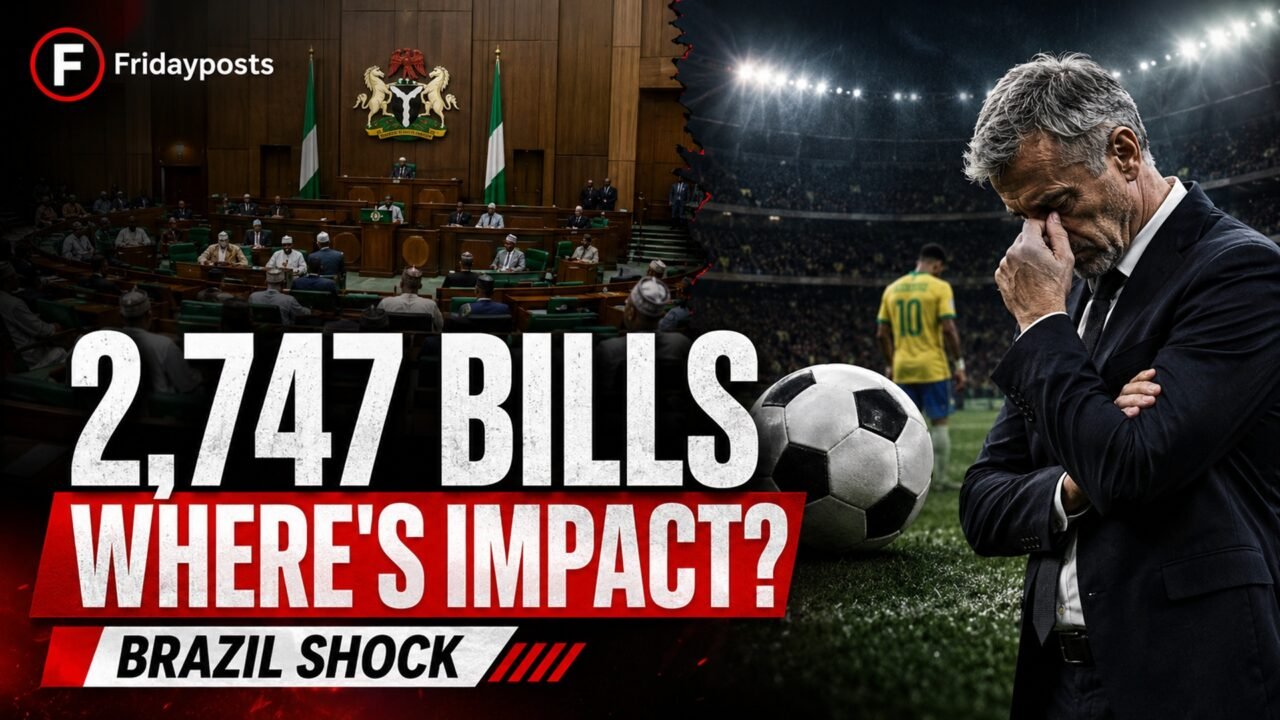
Nigeria’s House of Representatives says it introduced 2,747 bills and passed 363 bills in the first three years of the 10th National Assembly, presenting the figure as evidence of legislative activity and commitment to governance reforms.
But for many Nigerians, the real issue is not just the number of bills introduced. The real question is whether those bills are producing visible improvements in security, jobs, education, cost of living, public accountability, and institutional performance.
According to the House Committee on Rules and Business, the bills introduced since June 2023 include Executive bills, Senate concurrence bills, and a large number of private members’ bills.
In the third legislative session alone, the House reportedly introduced 484 bills, considered 220 motions, and handled several matters of urgent public importance.
On paper, this suggests a very active legislature. But in a country facing rising living costs, insecurity, unemployment, weak infrastructure, and public distrust, legislative activity must be measured against real-life outcomes.
Nigerians want impact, not just activity
The House listed some major legislative work, including the 2026 Appropriation Bill, Electoral Act 2026, tax reform measures, the Minimum Wage Act, and constitutional amendment proposals.
One of the most sensitive issues is the proposal for state police.
Supporters of state police argue that Nigeria’s security challenges require a more localised and responsive policing structure. They believe states should have stronger capacity to respond quickly to security threats within their territories.
Critics, however, fear that state police could be abused by governors, poorly funded, politicised, or turned into instruments of intimidation if not properly structured.
This means the real debate is no longer just whether Nigeria should create state police. The deeper issue is how it will be designed, funded, regulated, supervised, and protected from political abuse.
If Nigeria gets the structure wrong, state police may create new problems. But if it is properly designed, it could become one of the most consequential security reforms in the country’s democratic history.
Constitutional amendments must not be left to politicians alone
The House also disclosed that over 300 constitutional amendment proposals are at different stages of legislative consideration, with about 40 proposals expected to be voted on in the fourth legislative session.
This is important because constitutional reform affects the structure of government, the rights of citizens, the powers of institutions, and the future of Nigeria’s democracy.
Issues such as women’s representation, security, federalism, electoral reform, and governance restructuring cannot be treated as internal political matters only.
Civil society groups, professional bodies, traditional institutions, faith leaders, students, business communities, and ordinary citizens must pay attention.
Once the constitution changes, the country changes.
Do we need more institutions or better-performing institutions?
Another issue raised in the legislative scorecard is the increasing number of establishment bills, especially those creating federal institutions.
This has become a major question in Nigerian governance.
Do we need more agencies, commissions, schools, hospitals, and federal institutions, or do we need existing ones to perform better?
Creating a new institution can sound like progress. But without funding, competence, accountability, infrastructure, and measurable outcomes, a new institution can become another cost centre.
For Nigerians, the more important question should be:
How many bills improved security?
How many helped businesses survive?
How many reduced poverty?
How many improved education?
How many made public institutions more accountable?
How many directly improved the quality of life of citizens?
That is the kind of scorecard Nigerians should demand from lawmakers.
Public trust remains a major governance issue
Another headline raising public attention concerns reports around a CBN-related account opening process involving a public finance initiative, with officials stating that the process was inconclusive and that no funds had been released.
For many Nigerians, any mention of public funds, CBN accounts, government committees, and unclear communication immediately raises suspicion.
That reaction reveals a deeper national problem: public trust is low.
In a country where citizens are already worried about corruption, waste, and poor accountability, public institutions must communicate quickly, clearly, and transparently.
Silence creates rumours. Poor communication creates suspicion. Delayed explanation creates distrust.
If government institutions want citizens to believe them, they must make transparency a habit, not a reaction.
Brazil backs Ancelotti despite World Cup failure
Away from Nigeria, Brazil’s shocking exit from the 2026 FIFA World Cup has become one of the biggest global sports stories of the week.
The five-time world champions were knocked out in the Round of 16 after a surprise defeat to Norway, marking one of Brazil’s most disappointing World Cup campaigns in decades.
Despite the painful exit, Brazil’s football authorities have reportedly chosen to keep faith with head coach Carlo Ancelotti, insisting that the project will continue toward the 2030 World Cup.
That decision sends a major leadership message.
Many institutions panic after failure. They sack people immediately, abandon strategy, and start again from zero.
But not every failure means the vision is wrong. Sometimes, failure reveals the need for adjustment, patience, deeper diagnosis, and stronger execution.
Brazil now faces a major rebuilding moment. The country must study what went wrong, strengthen its system, and prepare for the next cycle.
The leadership lesson for Nigeria
There is a lesson here for Nigeria too.
Whether in football, politics, business, education, public service, or national development, serious institutions do not only celebrate victory. They also study failure.
They ask difficult questions.
What went wrong?
Who is accountable?
What must change?
What must continue?
What must be stopped?
What is the next measurable plan?
This is how institutions mature.
Nigeria’s lawmakers are presenting numbers. Citizens must demand outcomes.
Brazil has suffered a painful defeat. Its football leaders are choosing continuity over panic.
Across both stories, one truth stands out clearly: leadership is not measured by activity, titles, noise, or promises. Leadership is measured by results.
For Nigeria, the next phase of legislative work must prove that laws can move from paper to real impact.
For Brazil, the next World Cup cycle will test whether patience with Ancelotti was wisdom or sentiment.
For citizens, the lesson is simple: always look beyond the headline. Ask what the story means for institutions, accountability, leadership, and the future.
Fridayposts will continue to track the stories shaping Nigeria, Africa, and the world through a clear Nigerian and African lens.
