



Nigeria is again at a familiar crossroads. The country is not short of policies, committees, reforms, investigations or public statements. What it lacks, too often, is the kind of execution that convinces citizens that government can deliver security, accountability, economic stability and public trust.
That is the thread running through some of the biggest national headlines of the moment.
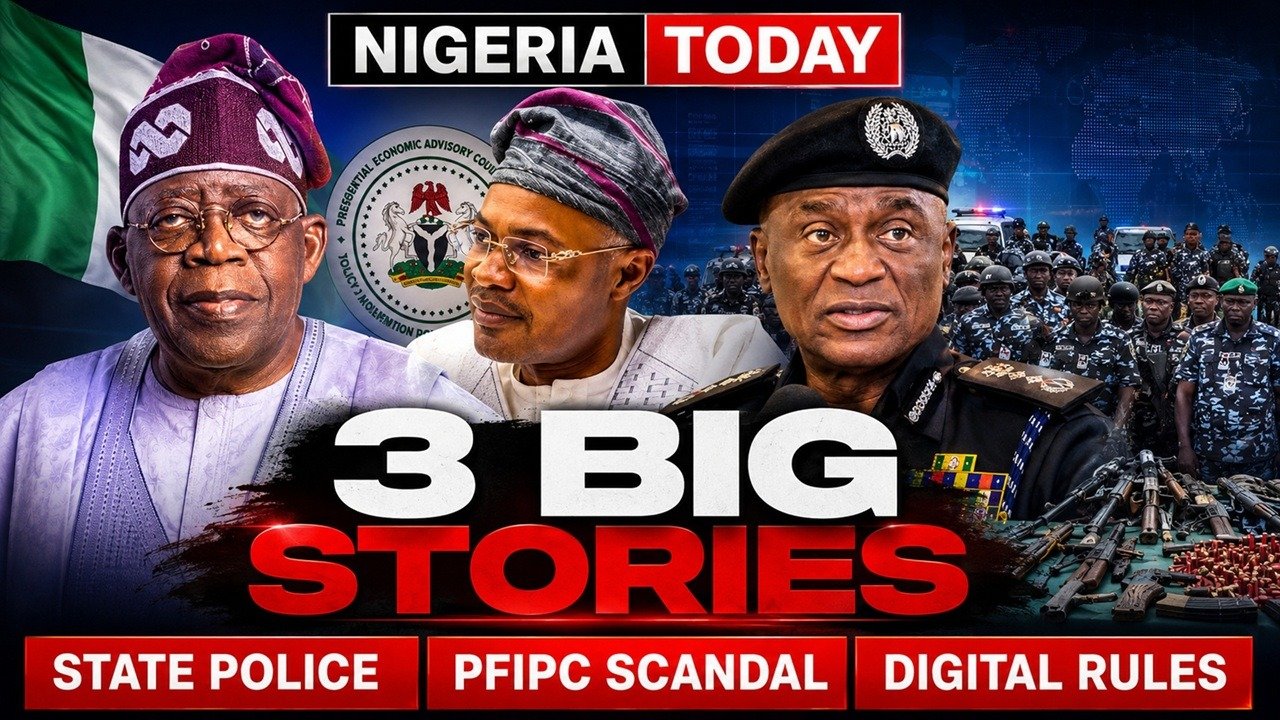
President Bola Tinubu has inaugurated a working group on the National Policing Bill, a move that pushes Nigeria closer to the long-debated question of state police. The Federal Government has suspended enforcement of new internet and digital platform regulations pending a harmonised national policy review. Tinubu has also ordered the Independent Corrupt Practices and Other Related Offences Commission, ICPC, to investigate the controversial Presidential Foreign Intervention Promotion Council, PFIPC, described in multiple reports as a fictitious body operating with the appearance of official recognition. Meanwhile, the Senate has called on the Federal Government to stop the rehabilitation of repentant Boko Haram members, the naira has weakened again around the ₦1,379/$ range in the official market, and the Nigeria Hydrological Services Agency has warned that more than 18 million Nigerians may be exposed to flooding in 2026.
These headlines may appear separate, but they are connected by one question: can Nigerian institutions still deliver trust, security and results?
This is not just a political question. It is a governance question. It is an economic question. It is a social question. And for ordinary Nigerians trying to survive rising costs, insecurity, job uncertainty, digital confusion and institutional distrust, it is a deeply personal question.
The bigger picture: Nigeria’s problem is no longer policy announcement
Nigeria knows how to announce reform.
There is almost always a new committee, a new framework, a new bill, a new task force, a new regulatory consultation, a new probe, a new presidential directive, a new agency, or a new national plan. On the surface, this suggests movement. But movement is not the same as progress.
The harder test is whether announcements become measurable outcomes.
If a state police bill moves forward, will it make communities safer or simply create another layer of coercive power? If ICPC investigates PFIPC, will Nigerians see real consequences or another quiet report? If digital regulations are suspended for harmonisation, will the final framework help startups, creators, fintechs and citizens, or will it return as another complicated compliance burden? If the Senate asks for an end to terrorist rehabilitation, will government produce a stronger justice and reintegration framework, or will the issue fade after public anger settles?
This is why today’s news matters. Each story tests a different pillar of national life.
State police tests Nigeria’s security architecture.
PFIPC tests public integrity and institutional due diligence.
Digital regulation tests the future of the digital economy.
The Boko Haram rehabilitation debate tests justice, national security and public confidence.
The naira tests economic management.
The flood warning tests disaster preparedness.
In all these areas, the country’s real weakness is not lack of public conversation. It is weak implementation.
State police: necessary reform or dangerous decentralisation?
The most politically consequential headline is President Tinubu’s move to operationalise state police through the National Policing Bill process.
According to reports, the President inaugurated a Presidential Working Group on the National Policing Bill at the Presidential Villa, Abuja, with the assignment of preparing a legal framework for implementing state police nationwide. Premium Times reported that Tinubu was represented at the inauguration by his Chief of Staff, Femi Gbajabiamila, while Channels Television reported that the committee was set up to prepare an implementation-ready draft bill after the constitutional amendment process.
For many Nigerians, state police is not a new idea. It has been debated for years. Governors have asked for it. Security experts have argued for it. Communities affected by kidnapping, rural banditry, armed robbery, farmer-herder violence and localised insecurity have often wondered why policing decisions must wait for distant central command structures.
The argument for state police is simple: Nigeria is too large, too diverse and too insecure to rely only on a heavily centralised police structure.
A police command designed for a country of more than 200 million people cannot easily respond to every local threat with speed, cultural intelligence and community knowledge. In many rural areas, criminals understand the terrain better than security agencies. In many communities, locals know the patterns of suspicious movement before formal institutions do. Yet the official security response is often slow, under-resourced or poorly coordinated.
This is why state police appears attractive.
It promises proximity. It promises speed. It promises local intelligence. It promises a policing system that can understand local languages, local disputes, local terrain and local security networks.
But Nigeria must not romanticise the idea.
State police can improve security. It can also become a dangerous instrument if badly designed.
The same governors who are expected to control state police are politicians. Some operate in states where democratic institutions are weak, state assemblies are dependent, local governments are controlled, civil society is vulnerable, and opposition politics is treated as a threat. In such environments, state police can become a tool for political intimidation.
So, the argument should not be “state police or no state police” alone.
The better question is: what kind of state police?
Who recruits?
Who trains?
Who funds?
Who disciplines?
Who investigates abuse?
Who protects citizens from political misuse?
What happens when a state governor uses state police against opposition figures?
Can a citizen sue effectively?
What role will federal oversight play?
Can state police cooperate with federal police without creating command confusion?
Will poorer states be able to fund professional police services?
Will there be minimum national standards?
Will personnel be recruited on merit, or will political loyalty become the hidden criterion?
These are not technical details. They are the heart of the reform.
Expert opinion: state police needs constitutional protection, not political enthusiasm
The strongest case for state police is also the strongest warning against rushing it.
Nigeria needs more localised security capacity. But Nigeria also has a long history of politicised institutions. Any state policing model that gives governors operational control without strong safeguards may simply transfer insecurity from one form to another.
A serious National Policing Bill should include at least five safeguards.
First, recruitment must be professional, transparent and insulated from partisan capture. A state police service must not become a ruling party security wing.
Second, funding must be predictable and audited. Security votes already suffer from opacity in many states. State police funding should not become another dark channel for political expenditure.
Third, complaints and oversight mechanisms must be independent. Citizens should be able to report abuse without fear of retaliation. Civil society, judiciary-linked bodies, human rights institutions and independent police complaints boards should have clearly defined roles.
Fourth, there must be a national minimum standard for training, weapons use, human rights compliance, investigation procedures and data reporting.
Fifth, state police must operate within a cooperative federal security architecture. Nigeria does not need rival police empires. It needs layered policing with clear jurisdiction.
If Nigeria gets the design right, state police could become one of the most important security reforms in the Fourth Republic. If Nigeria gets it wrong, it could become a machinery for local authoritarianism.
The lesson is clear: state police without accountability is not reform. It is risk.
PFIPC scandal: when a fake agency tests a real system
The second major story is the PFIPC scandal.
President Tinubu has ordered the ICPC to investigate the activities of the purported Presidential Foreign Intervention Promotion Council. Reports describe PFIPC as a fictitious body that allegedly operated with the appearance of government recognition. The Guardian reported that Tinubu gave the anti-corruption agency 30 days to investigate and submit a comprehensive report, while Punch reported that the President directed ICPC to investigate the purported council and all matters connected to it.
Vanguard reported that the investigation is expected to examine issues including the origin and use of false official documents, how recognition or diplomatic support may have been sought or obtained, bank account issues, movement of funds, and the roles of public officers, financial institutions, private individuals or intermediaries who may have enabled the alleged scheme.
This is not a small matter.
If an entity described as fictitious can gain enough attention to trigger presidential, legislative and anti-corruption responses, then the real scandal is not only the body itself. The deeper scandal is the weakness of verification systems in government.
In a functioning institutional environment, a fake government-linked body should not travel far. It should be caught early by basic due diligence.
Someone should verify its legal basis.
Someone should check whether it was created by law, executive authority or administrative instrument.
Someone should confirm whether its leadership was properly appointed.
Someone should verify whether its documents are authentic.
Someone should stop it from opening accounts, seeking recognition or engaging in official correspondence if it lacks legal backing.
The PFIPC controversy matters because it appears to expose the gap between official appearance and institutional verification.
Nigeria has many seals, letterheads, titles, appointments, committees, councils and government-looking platforms. In such a system, legitimacy can sometimes be manufactured through documents, access, associations and silence. Once a person or entity appears close enough to power, people may stop asking questions.
That is dangerous.
A democracy cannot run on assumed legitimacy. It must run on verifiable authority.
Expert opinion: PFIPC is not just about corruption, it is about system design
Many Nigerians will naturally view the PFIPC matter through the lens of corruption. That is understandable. But the issue goes beyond corruption.
It is also about system design.
A fake or questionable entity can only thrive where official verification is weak, institutional memory is poor, public records are hard to access, and insiders can create the appearance of legitimacy without immediate challenge.
Nigeria needs a government-wide verification architecture.
Every federal agency, commission, council, committee and programme should be traceable through a public digital registry. Citizens, banks, embassies, contractors, legislators, journalists and civil society actors should be able to confirm whether a body exists, when it was created, under what legal authority, who leads it, what budget line it has, and which ministry or office supervises it.
The country also needs tighter rules around the use of presidential titles. Anything carrying the word “Presidential” should face stricter authentication. The Presidency itself should maintain a live public register of presidential committees, councils, special initiatives and appointments.
Financial institutions should also bear responsibility. If an entity claims official status, banks should have a duty to verify its legal existence before opening accounts or processing transactions connected to public authority.
The ICPC investigation should therefore not end with identifying individuals. It should recommend procedural reforms.
The key questions are:
How did PFIPC present itself?
Who believed it?
Who enabled it?
Who failed to verify it?
Were public funds involved?
Were private funds collected?
Were official documents forged?
Were government offices misled?
Were officials complicit?
What internal controls failed?
And how can the system prevent recurrence?
If the investigation only names a few people but does not fix the loopholes, the scandal will repeat under another name.
Digital regulation: a pause that could save Nigeria’s innovation economy
The third major story is the Federal Government’s suspension of new internet and digital platform regulations.
Punch reported that the Federal Government suspended new internet regulations affecting digital platforms and online intermediaries pending a harmonised policy framework. Vanguard also reported that enforcement of new regulations affecting internet platforms, online intermediaries and other cross-cutting digital economy issues had been suspended pending completion of a national policy review. TechCabal described the move as a major attempt to halt overlapping rules and create a single regulatory framework for the digital economy.
This decision matters more than many people realise.
Nigeria’s digital economy is no longer a side sector. It affects banking, media, advertising, education, entertainment, e-commerce, fintech, artificial intelligence, content creation, logistics, software development, online work, youth employment and cross-border services.
For millions of young Nigerians, the internet is not just a place for entertainment. It is a workplace. It is a marketplace. It is a classroom. It is a publishing platform. It is a payment rail. It is a business address. It is an opportunity infrastructure.
So digital regulation must be handled carefully.
Regulation is necessary. No serious digital economy can operate without rules on data protection, consumer rights, fraud prevention, platform accountability, cybersecurity, competition, harmful content, child safety and digital taxation.
But regulation becomes harmful when it is fragmented, duplicative, unpredictable or poorly coordinated.
If NCC issues one rule, NITDA issues another, NDPC issues another, FCCPC has another enforcement position, and other agencies begin to add their own requirements, businesses face confusion. Startups cannot plan. Investors become cautious. Compliance costs rise. Small businesses suffer first. Innovation slows down.
This is why harmonisation is important.
A digital business should not need to hire a room full of lawyers just to understand which regulator has authority over one product feature.
Expert opinion: Nigeria must regulate the digital economy without suffocating it
The Federal Government’s suspension of overlapping digital rules is a positive step, but only if it leads to a better framework.
Nigeria needs a digital regulation model that is clear, innovation-friendly and citizen-protective.
The first principle should be regulatory clarity. Businesses must know which agency regulates what. If a platform processes user data, hosts content, enables payment, provides telecom infrastructure and sells advertising, there must be a clear map of regulatory responsibilities.
The second principle should be proportionality. A small creator platform, a local e-commerce site and a multinational social media platform should not face the same compliance burden. Regulation should scale according to risk, size, reach and sector sensitivity.
The third principle should be consultation. Startups, creators, fintechs, civil society, consumer groups, data experts, cybersecurity professionals, lawyers, investors and ordinary users should be part of the process. A digital policy written only from the perspective of government control will not serve the economy.
The fourth principle should be enforcement discipline. Regulators must not use digital rules as revenue traps. Fines, permits and compliance demands should not become a new form of bureaucratic taxation.
The fifth principle should be future-readiness. Artificial intelligence, deepfakes, creator monetisation, digital identity, cross-border payments, data localisation, online education and platform accountability are already shaping the economy. Nigeria’s framework must be flexible enough to adapt.
The country has a rare opportunity. It can create one of Africa’s clearest digital governance frameworks. But it must avoid the temptation to regulate before understanding.
A good digital policy should protect citizens and still allow innovation to breathe.
Security beyond state police: the Boko Haram rehabilitation debate
Another headline that deserves attention is the Senate’s call for the Federal Government to stop the rehabilitation of repentant Boko Haram members.
TheCable reported that the Senate called on the Federal Government to discontinue the rehabilitation programme following deliberations on the country’s security situation. Vanguard reported that the resolution followed an additional prayer by Senator Joseph Ikpea, who argued that rehabilitation and reintegration had become a matter of growing public concern.
This debate is emotionally charged, and understandably so.
For communities that have suffered attacks, killings, displacement, abductions and loss of livelihoods, the idea that former terrorists can be rehabilitated and returned to society is deeply painful. Many victims feel abandoned. Many soldiers have paid the ultimate price. Many families have never recovered from the trauma.
So when citizens hear about rehabilitation, they often ask: where is justice for victims?
That question matters.
At the same time, counterinsurgency experts often argue that not every person associated with an insurgent group has the same level of guilt, command responsibility or ideological commitment. Some may have been abducted. Some may have been coerced. Some may have been minors. Some may have surrendered. Some may have committed crimes that require prosecution. Others may require deradicalisation, monitoring and reintegration.
The challenge is that Nigeria must distinguish clearly between categories.
A blanket rehabilitation policy can look unjust.
A blanket rejection of reintegration can also create long-term security complications.
The better path is a transparent, justice-led framework.
Those who committed crimes should face prosecution.
Those who were coerced, abducted or recruited as minors should be processed through a separate justice and rehabilitation pathway.
Communities must be consulted before reintegration.
Victims must receive support, compensation, trauma care and justice.
Security agencies must monitor reintegrated persons.
The process must not be secretive.
Public anger grows when citizens believe repentant insurgents are treated better than victims, soldiers or displaced families.
Naira at ₦1,379/$: stability is still fragile
The naira remains another important signal of public confidence.
Channels Television reported that the naira depreciated to ₦1,379 per dollar in the Nigerian Foreign Exchange Market, citing CBN data, while noting that the currency also slipped in the parallel market. Vanguard, reporting the previous day’s exchange rate, placed the official NFEM rate at ₦1,367.29/$1 and the parallel market around ₦1,400/$1.
Currency movement may appear technical, but it directly affects households and businesses.
When the naira weakens, import costs rise. Businesses that depend on imported inputs face higher costs. Parents paying foreign school fees feel it. Medical importers feel it. Manufacturers feel it. Tech businesses paying for foreign software subscriptions feel it. Even local traders feel it because many supply chains are dollar-sensitive.
The narrowing gap between official and parallel rates can be seen as a positive sign, but Nigerians care most about price stability. If the exchange rate appears stable but food, transport, rent, medicine and school fees remain high, citizens will not feel relief.
This is why economic management must connect macro indicators to household realities.
The government may point to reforms, exchange-rate alignment, foreign investor confidence and reserve management. Those are important. But the political test of economic reform is the market woman, the salary earner, the SME owner, the unemployed graduate and the family trying to survive a month.
If reforms do not translate into confidence, affordability and opportunity, citizens will remain sceptical.
Flood warnings: disaster preparedness is governance too
NiHSA’s flood warning should not be treated as a routine seasonal alert.
Vanguard reported that NiHSA warned that more than 18 million Nigerians may be exposed to flooding in 2026, with potential impact on farmlands, educational facilities and healthcare facilities. The Guardian had earlier reported NiHSA’s warning that flooding in parts of Nigeria could persist till September and may pollute drinking water.
Flooding is not just an environmental story. It is an economic, public health and food security story.
When floods destroy farms, food prices rise.
When floods damage schools, children lose learning time.
When floods affect health facilities, communities lose access to care.
When floods contaminate water, cholera and other waterborne diseases become more likely.
When floods displace people, poverty deepens.
When roads and bridges collapse, trade slows.
Disaster preparedness is one of the clearest tests of government seriousness because flood risks are often predictable. If an agency warns early, then the responsibility shifts to states, local governments, emergency agencies, ministries, community leaders and citizens.
Early warning is only useful when it becomes early action.
States must clear drainages.
Communities must be warned in local languages.
High-risk areas must be mapped.
Schools and health facilities must have contingency plans.
Emergency shelters must be identified.
Farmers must receive practical advisories.
Insurance and compensation systems must be improved.
Flooding will not wait for press conferences.
The common thread: trust is Nigeria’s scarcest public asset
Across these stories, one word keeps returning: trust.
State police requires trust because citizens must believe it will protect them rather than oppress them.
PFIPC requires trust because citizens must believe government can detect fraud, punish wrongdoing and protect public institutions.
Digital regulation requires trust because innovators must believe regulators want to build, not suffocate.
Boko Haram policy requires trust because victims must believe justice is not being sacrificed for convenience.
Currency management requires trust because businesses must believe the market will not be thrown into sudden disorder.
Flood preparedness requires trust because citizens must believe warnings will be followed by action.
Trust is not built by statements. It is built by consistency.
When government announces reform but fails to execute, trust falls.
When scandals emerge but nobody is punished, trust falls.
When citizens report abuse but nothing happens, trust falls.
When regulations change suddenly, trust falls.
When agencies contradict one another, trust falls.
When public officers act with impunity, trust falls.
Nigeria cannot build a strong economy, secure society or credible democracy on low trust.
The Fridayposts view: Nigeria must move from activity to accountability
The most important conclusion from today’s headlines is this: Nigeria needs less performative governance and more accountable execution.
It is not enough to inaugurate a committee on state police. Nigerians need a bill that is technically sound, constitutionally clear, operationally realistic and democratically safe.
It is not enough to order an ICPC investigation into PFIPC. Nigerians need a report, named responsibilities, institutional reforms and consequences where wrongdoing is established.
It is not enough to suspend digital regulations. Nigeria needs a harmonised framework that protects citizens, supports business and removes regulatory confusion.
It is not enough for the Senate to condemn rehabilitation of former insurgents. Nigeria needs a justice-based security framework that protects victims, prosecutes criminals and manages surrender cases transparently.
It is not enough to report exchange-rate movement. Nigeria needs policies that help businesses plan, reduce import pressure, grow exports and stabilise household costs.
It is not enough to warn about floods. Nigeria needs evacuation planning, drainage action, state-level preparedness and community mobilisation.
The problem is not that Nigeria lacks ideas. The problem is that ideas often die between announcement and implementation.
What citizens should watch next
Nigerians should watch five things closely in the coming weeks.
First, the National Policing Bill process. Citizens should ask whether the draft includes safeguards against political abuse. Civil society groups, lawyers, security experts and state-level stakeholders should not wait until the bill is final before engaging.
Second, the PFIPC investigation timeline. The 30-day deadline should not disappear quietly. Nigerians should demand publication of findings or at least a clear public summary. The investigation should not be reduced to personality drama.
Third, the digital policy review. Startups, creators, fintechs, media operators and digital rights advocates should participate actively. Silence from the ecosystem will allow regulators to design rules without enough practical understanding.
Fourth, the Boko Haram rehabilitation debate. Nigerians should demand a balanced approach that combines justice, security intelligence, victims’ rights and transparent reintegration where appropriate.
Fifth, flood preparedness. State governments should not wait for disaster before acting. Citizens in flood-prone areas need practical information now, not sympathy later.
What government must do differently
Government must now learn to communicate with clarity.
On state police, it should explain the safeguards being proposed.
On PFIPC, it should publish the institutional lessons from the investigation.
On digital regulation, it should present a clear harmonisation roadmap.
On insecurity, it should communicate how prosecution, rehabilitation, intelligence and victims’ support fit together.
On the naira, it should connect macroeconomic policy to business confidence and cost-of-living relief.
On floods, it should move from warning to preparation.
This is the difference between government announcement and public leadership.
Citizens do not simply want to hear that government is working. They want to see how the work affects their safety, income, rights, businesses and communities.
Final analysis: the real story is institutional credibility
The biggest Nigerian story today is not only state police. It is not only PFIPC. It is not only digital regulation.
The bigger story is institutional credibility.
Can Nigeria build a policing system that is closer to the people and still accountable?
Can Nigeria investigate a fake agency scandal without protecting powerful interests?
Can Nigeria regulate the internet without damaging innovation?
Can Nigeria confront terrorism without ignoring justice?
Can Nigeria manage the naira in a way that restores confidence?
Can Nigeria prepare for floods before they become tragedy?
These are the questions that define serious governance.
Nigeria does not need more noise. Nigeria needs institutions that work.
The country does not need more committees that fade after the cameras leave. It needs implementation, discipline and public accountability.
State police must not become state oppression.
PFIPC must not become another forgotten scandal.
Digital regulation must not become a brake on the future economy.
Security policy must not ignore victims.
Economic reform must not forget households.
Flood warnings must not become annual rituals of avoidable tragedy.
If today’s headlines teach anything, it is that Nigeria’s future will not be shaped by announcements alone. It will be shaped by whether leaders can turn policy into protection, investigation into justice, regulation into growth, and public office into public trust.
That is the test before the country.
And that is why Nigerians must keep asking the hard questions.
Which institutions are working?
Who is accountable?
What changed after the announcement?
Who benefits?
Who suffers?
What results can citizens see?
Until those questions are answered clearly, the work of democracy remains unfinished.
This is Fridayposts: global issues, Nigerian lens, clear insight.
