



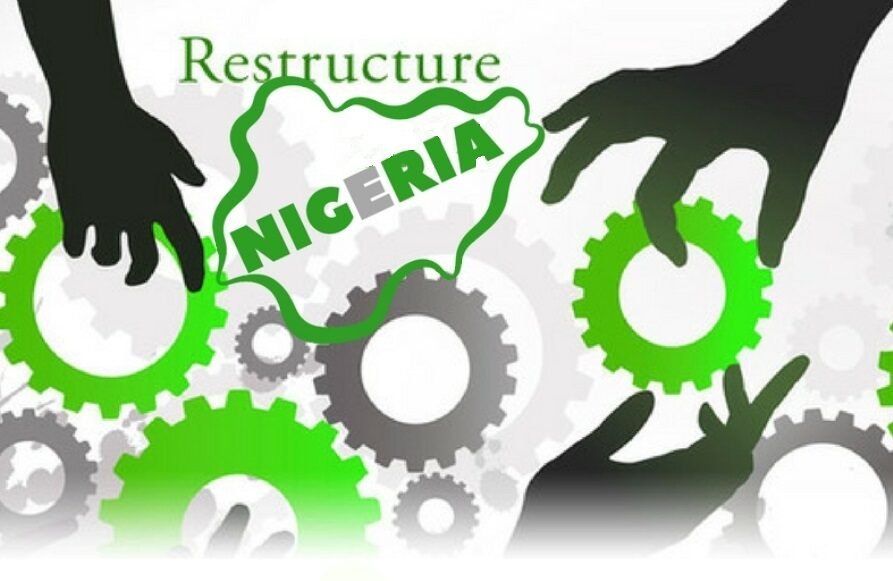
For decades, Nigeria has wrestled with the tension between its vast potential and its recurring crises. A country blessed with natural resources, youthful population, and strategic geography should by now be a global powerhouse. Instead, it remains trapped in cycles of poverty, insecurity, corruption, and uneven development. At the heart of this paradox is one word that keeps resurfacing in political and civic debates: restructuring.
When the Secretary to the Government of the Federation (SGF), Senator George Akume, declared recently that restructuring is key to Nigeria’s sustainable development, he reignited a national conversation that has refused to die. Nigerians may differ on what restructuring means, but there is growing consensus that the current system is not working, and that true progress requires a bold redesign.
What Restructuring Really Means
For some, restructuring means political decentralization — giving more autonomy to states and local governments. For others, it is about economic federalism, ensuring that regions can harness and control their resources while contributing fairly to the federation. Still others view restructuring through the lens of social justice, equity, and representation.
At its core, restructuring is about realigning power, responsibility, and resources in a way that promotes fairness, efficiency, and sustainability. It is not simply a constitutional tweak; it is a fundamental rethinking of how Nigeria is governed.
Why the Call for Restructuring Persists
Nigeria’s current federal structure is widely seen as lopsided. The 1999 Constitution concentrates too much power at the center, leaving states financially dependent and administratively weak. This imbalance has several consequences:
-
Overburdened Federal Government: Abuja struggles to manage everything from policing to electricity, leading to inefficiency.
-
Weak States: Most states rely on federal allocations rather than building independent economies.
-
Injustice in Resource Control: Oil-producing regions feel exploited, while non-oil states complain of neglect.
-
Insecurity: Centralized policing leaves communities vulnerable, as local contexts are ignored.
The persistence of these issues explains why restructuring has remained a rallying cry across generations — from political leaders and activists to civil society groups and ordinary Nigerians.
The Economic Argument for Restructuring
Sustainable development requires an economy that is both inclusive and resilient. Nigeria’s current system undermines both.
-
Resource Dependence
The heavy reliance on oil revenue shared by the federation discourages innovation and diversification. States that could thrive on agriculture, mining, or technology remain dependent on monthly allocations. -
Stifled Enterprise
Over-centralization creates bottlenecks for businesses. For instance, power generation and distribution are trapped in federal bureaucracy, preventing states from tailoring energy solutions to their industries. -
Fiscal Irresponsibility
States, knowing they will receive federal handouts, often fail to cultivate revenue bases or practice fiscal discipline. Restructuring could create incentives for states to become more entrepreneurial.
In short, without restructuring, Nigeria will continue recycling poverty and underdevelopment. With restructuring, the country could unleash regional strengths and create a more balanced, dynamic economy.
The Political Dimension
Politically, restructuring addresses the long-standing question of representation and fairness. Nigeria is a multi-ethnic, multi-religious state, and without equitable distribution of power, unity remains fragile.
-
Devolution of Powers would allow regions to manage their affairs in line with local realities.
-
State Policing could enhance security by bringing law enforcement closer to the people.
-
Electoral Reforms tied to restructuring could reduce tensions around federal elections, since the stakes would not be as disproportionately high.
Restructuring, therefore, is not merely about governance efficiency; it is about national stability and cohesion.
The Social and Cultural Angle
Nigeria’s diversity is both a strength and a challenge. Restructuring could help manage that diversity more effectively.
-
Cultural Autonomy: Regions could promote their unique languages, traditions, and systems without fearing marginalization.
-
Equitable Development: By decentralizing resources, less developed areas could accelerate growth according to their peculiar needs.
-
Conflict Mitigation: Many inter-ethnic and regional disputes are rooted in perceived imbalances. Fairer structures could ease tensions.
Thus, restructuring becomes a tool not just for economic development but for social harmony.
What Restructuring Could Look Like in Practice
Restructuring is not a vague aspiration. It requires concrete policy steps:
-
Constitutional Amendment
Amending the 1999 Constitution to devolve more powers to states, including control over police, electricity, and resource management. -
Revenue Sharing Reform
Allowing states to keep a larger portion of their internally generated revenue while contributing an agreed percentage to the center. -
Regional Collaboration
Encouraging states to collaborate regionally, as in the days of the Western Region’s cocoa-driven development or the Northern Region’s groundnut pyramids. -
Judicial Autonomy
Strengthening state judiciaries to interpret and enforce laws in line with local realities. -
Phased Implementation
Restructuring does not have to be a sudden overhaul; it can be phased, starting with sectors like policing and power.
Implications for Businesses
For Nigerian businesses, restructuring is not a distant constitutional matter; it has immediate implications:
-
Ease of Doing Business: Decentralized regulation could mean faster approvals, less bureaucracy, and more tailored policies.
-
Infrastructure Development: States empowered to generate power or invest in transportation would create better operating environments.
-
Competition and Innovation: States competing for investors would drive innovation and efficiency.
-
Risk Diversification: Businesses would no longer be entirely at the mercy of federal policies; they could engage with responsive state governments.
Restructuring could therefore unleash a new era of business confidence and foreign investment.
Implications for Citizens
For ordinary Nigerians, restructuring could translate into:
-
Better local governance and service delivery.
-
Improved security through state policing.
-
Greater accountability of leaders, as states take ownership of their destinies.
-
Opportunities for employment and entrepreneurship as states diversify economies.
Citizens would feel more connected to government, reducing alienation and apathy.
Implications for Government
For the federal government, restructuring might seem like surrendering power, but in reality, it could:
-
Reduce Burden: Free the center from trying to manage every detail of governance.
-
Enhance Legitimacy: A more balanced system could restore trust in national institutions.
-
Strengthen Unity: True federalism could replace the current fragile unity with one rooted in fairness and equity.
For state governments, restructuring means greater responsibility. They would no longer hide behind Abuja; they would need to prove competence and deliver results.
Risks and Challenges
Restructuring is not a magic wand. It comes with risks:
-
Elite Resistance: Many political elites benefit from the current imbalance and may resist change.
-
Implementation Complexity: Amending the constitution and building consensus across regions will be difficult.
-
Mismanagement at State Level: Some states may squander new powers without delivering real progress.
These risks, however, are outweighed by the risks of inaction — continued stagnation, rising insecurity, and potential disintegration.
Restructuring as the Path to Sustainable Development
Nigeria cannot achieve sustainable development by relying on outdated structures designed for another era. Restructuring is not a threat to national unity; it is the foundation for true federalism, balanced development, and enduring peace.
For businesses, restructuring promises opportunity. For citizens, it offers empowerment. For government, it provides legitimacy. And for Nigeria as a whole, it is the bridge from potential to performance.
The question is not whether Nigeria can afford to restructure, but whether it can afford not to. Without restructuring, the dream of sustainable development will remain elusive. With it, Nigeria could finally unlock the future it deserves.
